
Paul Signac

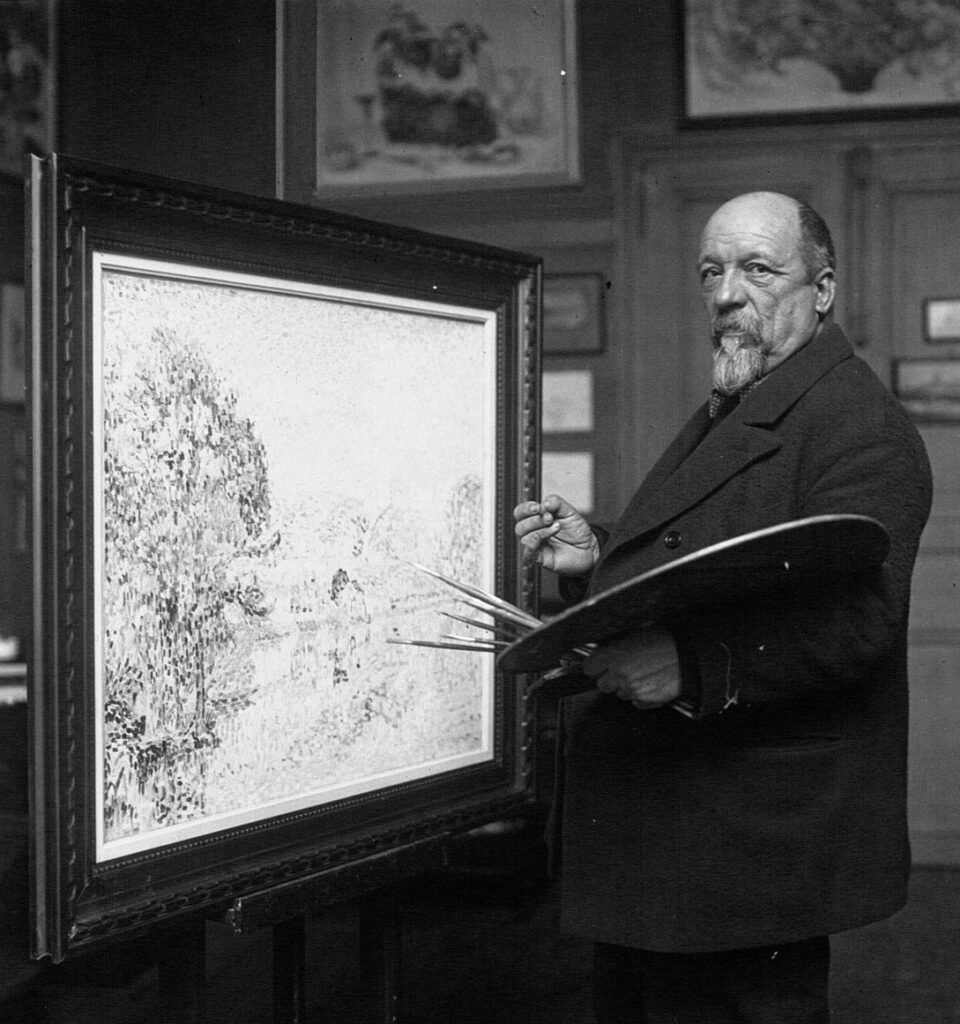
November 11, 1863 – August 15, 1935 (Paris, France)
Paul Signac was a French painter who played a key role in the development of Neo-Impressionism and was one of the main representatives of Pointillism. He was born into a well-off family and from a young age he showed an interest in art, although he was initially attracted to architecture. After visiting Impressionist exhibitions, he decided to devote himself to painting and began training as a self-taught artist, influenced by painters of Impressionism.
In the mid 1880s he met the painter Georges Seurat, with whom he developed the foundations of Neo-Impressionism. Together they explored a pictorial technique based on scientific principles of color, applying small brushstrokes or dots of pure pigment that blend optically in the viewer’s eye. This method, known as Pointillism, sought to achieve greater luminosity and chromatic harmony in painting.
Throughout his career, Signac showed a particular interest in maritime landscapes and views of ports. He traveled frequently along the Mediterranean coast and other regions of Europe, painting scenes of harbors, boats, and coastal towns. In 1892 he settled in Saint-Tropez, where he found constant inspiration in the light of the Mediterranean. His paintings from this period are characterized by vibrant colors, balanced compositions, and a luminous atmosphere.
In addition to his work as a painter, Signac played an important role as a theorist and advocate of Neo-Impressionism. In 1899 he published the book From Eugène Delacroix to Neo-Impressionism, in which he explained the aesthetic and scientific principles of the movement. He also served as president of the Salon des Indépendants, an institution that promoted artistic freedom and provided exhibition opportunities for avant-garde artists.
Today Paul Signac is recognized as one of the key figures of Neo-Impressionism and as an artist who helped renew painting through his research on color and light. His works are preserved in major international museums such as the Musée d’Orsay, The Metropolitan Museum of Art (New York), and the Museum of Modern Art (New York), where they continue to be admired for their chromatic intensity and technical innovation.