
Marc Chagall

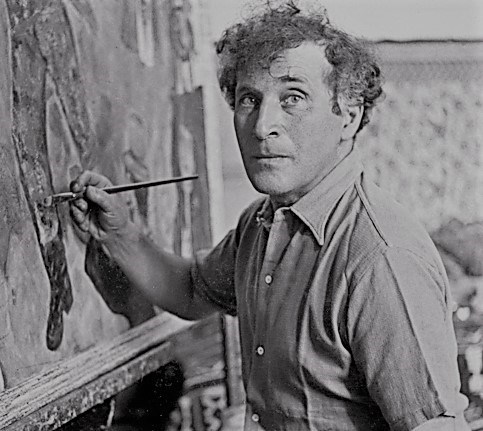
July 7, 1887 (Liozna, Belarus) – March 28, 1985 (Saint-Paul-de-Vence, France)
Marc Chagall was born in Belarus into a Jewish family within the Russian Empire. After studying in Vitebsk, he entered the Academy of Fine Arts in Saint Petersburg, where his teacher, Léon Bakst, introduced him to the European avant-garde. Eager to immerse himself in this artistic world, he moved to Paris between 1910 and 1914, introducing himself into the different artistic movements. Through the study of the great masters of the Louvre Museum and the observation of Fauvism and the emerging Cubism, he developed a unique style inspired by many influences but not bound to any particular school. With his free use of form and color, infused with the symbolic imagery of Jewish faith and Russian folk art, Chagall quickly established himself as a central figure of the School of Paris. Apollinaire called him the “painter of surreality,” capturing the dreamlike and sacred interplay in his canvases.
He definitely left Russia after a final stay, from 1919 to 1922, during which he founded and directed an art school in Vitebsk, and decorated the Moscow theater. He also visited Berlin in 1914, where he got international recognition. He settled permanently in Paris, where he soon signed with the art dealer Ambroise Vollard. His reputation extended across the Atlantic since he went into exile in New York during World War II, where the MoMA organized an exhibition for him in 1946. He also designed the sets for the ballets Aleko by Tchaikovsky and The Firebird by Stravinsky. In 1944, his wife Bella Rosenfeld suddenly passed away, but her image -the muse and companion of his life- continued to inhabit his work until his own death.
The turbulence of two world wars never diminished the poetic, dreamlike quality of his art. Returning to France in 1948, Chagall settled in Saint-Paul-de-Vence, where he frequently met with Matisse and Picasso. He broadened his artistic repertoire, experimenting with ceramics, mosaics, tapestries, sculpture, and stained glass. Tirelessly productive, he continued to receive major public commissions: the stained glass windows of Reims Cathedral (1958) and Metz Cathedral (1968), as well as the ceiling of the Palais Garnier, commissioned by André Malraux in 1963. In 1977, Valéry Giscard d’Estaing awarded him the Legion of Honour, and Teddy Kollek, mayor of Jerusalem, named him an honorary citizen of the city. Universally celebrated, Chagall was honored with a major retrospective in 1985, the year of his death, at the Royal Academy of Arts in London. Today, his work continues to captivate with its vibrant colors and ethereal vision, preserved in the world’s most prestigious museum and private collections, from the Montreal Museum of Fine Arts to the Solomon R. Guggenheim Museum in New York.
Exhibitions
-
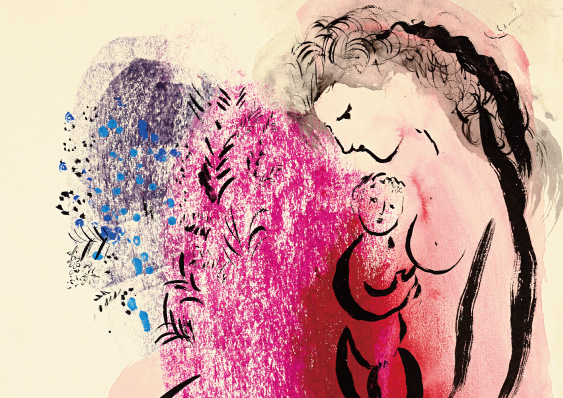
Marc Chagall ― Love and Longing Expressed Through Diverse Techniques
7 March 2026 - 5 April 2026 / OSAKA -
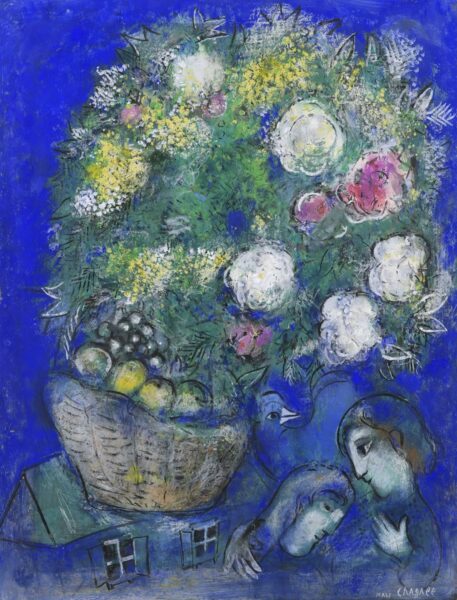
Marc Chagall:40 Years in Remembrance
8 November 2025 - 21 December 2025 / TOKYO -
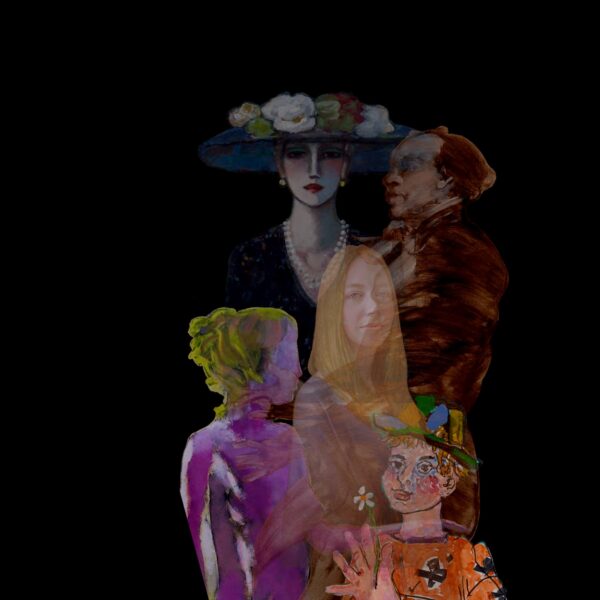
FIGURES
22 September 2022 - 10 October 2022 / OSAKA -
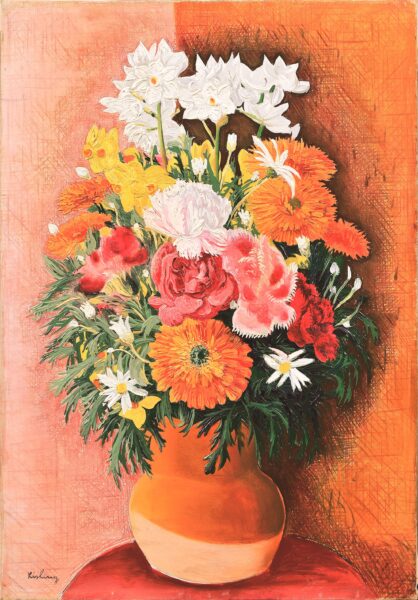
花展╶ 百花繚乱╶
31 October 2020 - 13 December 2020 / TOKYO -
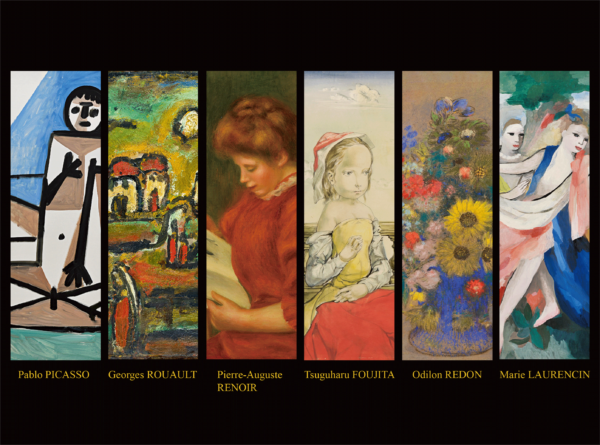
chefs-d’œuvre de la galerie taménaga
6 March 2020 - 12 April 2020 / OSAKA
News


Publications
-
Chefs-d’oeuvre