

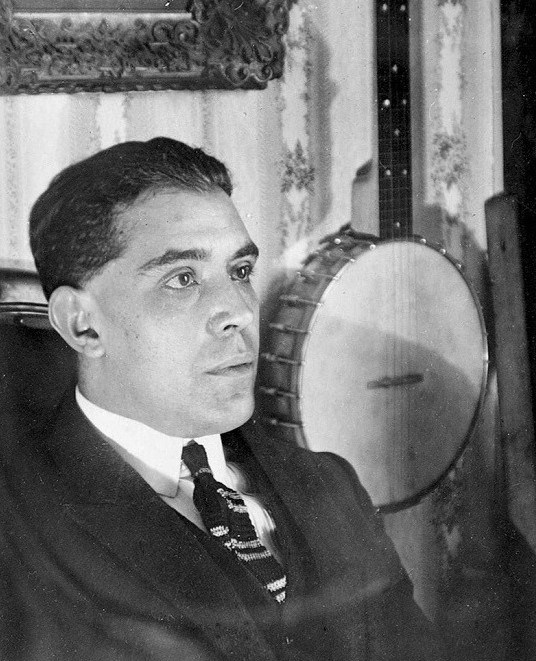
March 23, 1887 (Madrid, Spain) – May 11, 1927 (Boulogne-Billancourt, France)
While studying industrial drawing and earning a living producing press illustrations, Juan Gris decided to pursue a career as a painter and moved to Paris in 1906. He settled in the center of the avant-garde at a studio in the Bateau-Lavoir, where he befriended artists such as Matisse, Braque, Léger, Modigliani, and Picasso. Fascinated as he witnessed the birth of Les Demoiselles d’Avignon in 1906, he enthusiastically joined the Cubist explorations led by its founders, Picasso and Braque. He practiced the deconstruction of planes and the variation of angles. With his painting Homage to Picasso, created and exhibited in 1912 at the Salon des Indépendants, Juan Gris became the first artist to join the movement.
Despite this, Juan Gris developed a distinctive style of his own. His canvases from 1916 to 1919 particularly reveal his bold use of color, in contrast to those of Picasso and Braque, which were built in monochromatic tones. Using a vivid and harmonious palette, similar to the style of his friend Matisse, he captivates through the multiplicity of planes and combinations, with which he seeks to create a dialogue between forms. Made of rhythms and visual echoes, his painting tends toward simple and effective compositions from which a true sense of poetry emerges.
From 1912 onward, after approaching abstraction and hermeticism, Analytical Cubism began to lose momentum. Gradually, artists reintroduced signs of readability into their compositions, incorporating elements from everyday life, leading to a third stage known as Synthetic Cubism. Juan Gris contributed fully to this development and was no longer seen as merely a disciple. Later, in 1924, he delivered a now-famous lecture at the Sorbonne on this subject titled “Des Possibilités en peintures” (“On the Possibilities in Painting”). Dalí described him as “the greatest of the Cubist painters, more important than Picasso because he is more truthful.” Indeed, Juan Gris sought to create new compositional laws aimed at representing the truth of the object, revealed in a kind of “flat and colored architecture.”
By giving Cubism a new direction, his paintings gained wide recognition and were exhibited in major cities across Europe. He then signed an exclusive contract with the dealer Daniel-Henry Kahnweiler and was commissioned by Sergei Diaghilev to design sets for his famous Ballets Russes between 1922 and 1923. He died prematurely in 1927 at the age of 40, and he is considered a key figure of Cubism. Today, his works are held in prestigious institutions such as the Museum of Modern Art in New York-which dedicated a major retrospective to him in 1958-,the Tate in London and the Kunstmuseum Basel.
Publications
-
Chefs-d’oeuvre