
Raoul Dufy

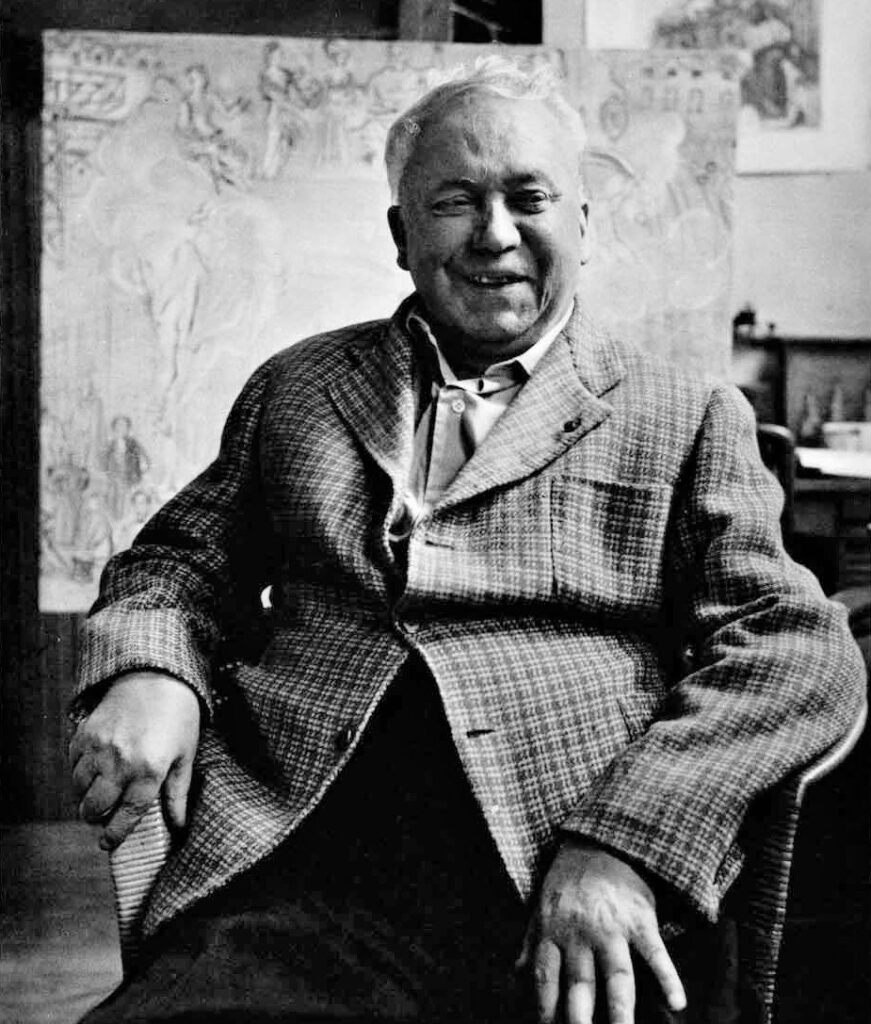
June 3, 1877 (Le Havre, France) – March 23, 1953 (Forcalquier, France)
Although he embraced Impressionism, Fauvism and Cubism, this genius of color and drawing remains an artist who defies classification. After initial training with Charles Lhuillier in Le Havre, Dufy entered the École Nationale Supérieure des Beaux-Arts in Paris in 1900, studying in Léon Bonnat’s studio alongside his friend Othon Friesz.
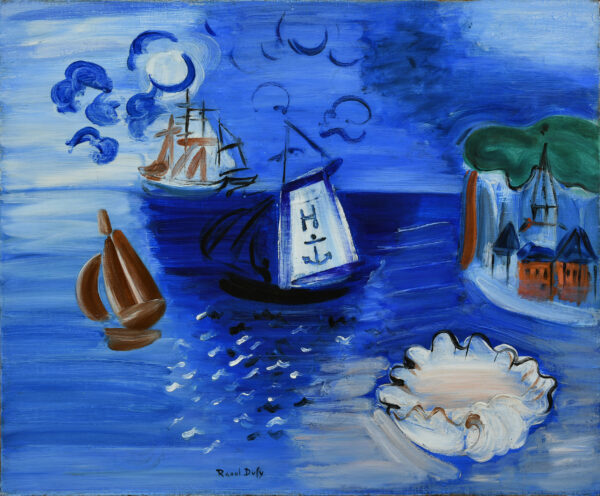
Initially influenced by the impressionist painting of the Le Havre artist Eugène Boudin, Dufy adopted the bold shadows and vivid colors of the Fauves influenced by the scandal of the Salon d’Automne in 1905. However, this influence lasted only a few years in his career, as the Cézanne retrospective in 1907 drew him toward new explorations. Then, he went to L’Estaque with his friend Braque to paint motifs inspired by the great master from Aix, and the following year he explored a new pictorial expression after discovering Cézanne-inspired Cubism with Picasso (1908–1910). Although fully aware of the major artistic discoveries of the early 20th century, Dufy developed a highly personal style. Through his keen observation of life, he perceived a certain independence of color from the object, particularly in the movement perception. This revelation led him to separate the black-line contour from the forms and colors, which spread across the canvas in luminous patches. This aesthetic, developed especially through watercolor and gouache techniques, became the painter’s immediately recognizable signature.
The appealing joy that radiates from each of his paintings brought him numerous commissions. On the advice of Apollinaire, with whom he collaborated on the illustration of his Bestiary in 1910, he began working on textile designs, an area in which he excelled: in 1911 with the famous couturier Paul Poiret, then with the Lyon silk manufacturer Blancini-Férier in 1912, and later with the Beauvais tapestry manufactory in 1931. He also explored the ceramic arts in 1923, working with the Catalan ceramist Artigas. Although many collectors were fascinated by his radiant paintings, it is impossible not to mention his most monumental work: a vast 625 m² painting created for the Electricity Pavilion at the 1937 World’s Fair, La Fée Electricité, that remains to this day the largest painting in the world. In 1952, his participation in the 26th Venice Biennale earned him the International Grand Prize for Painting. He passed away the following year.
Today, his works are held in many international collections such as the Museum of Modern Art in New York, the Musée d’Orsay, and the Hermitage Museum in Saint Petersburg, demonstrating both their aesthetic appeal and their major significance in the history of art.
Exhibitions
News

Publications
-
Chefs-d’oeuvre